The climate community increasingly agrees on one thing: the world will need 6–10 gigatons of carbon removal every year by 2050. Biochar has emerged as one of the most promising solutions because it does more than remove carbon — it converts waste biomass into renewable energy and stable carbon that can remain locked away for centuries.
Yet there is an uncomfortable reality that the biochar industry must confront.
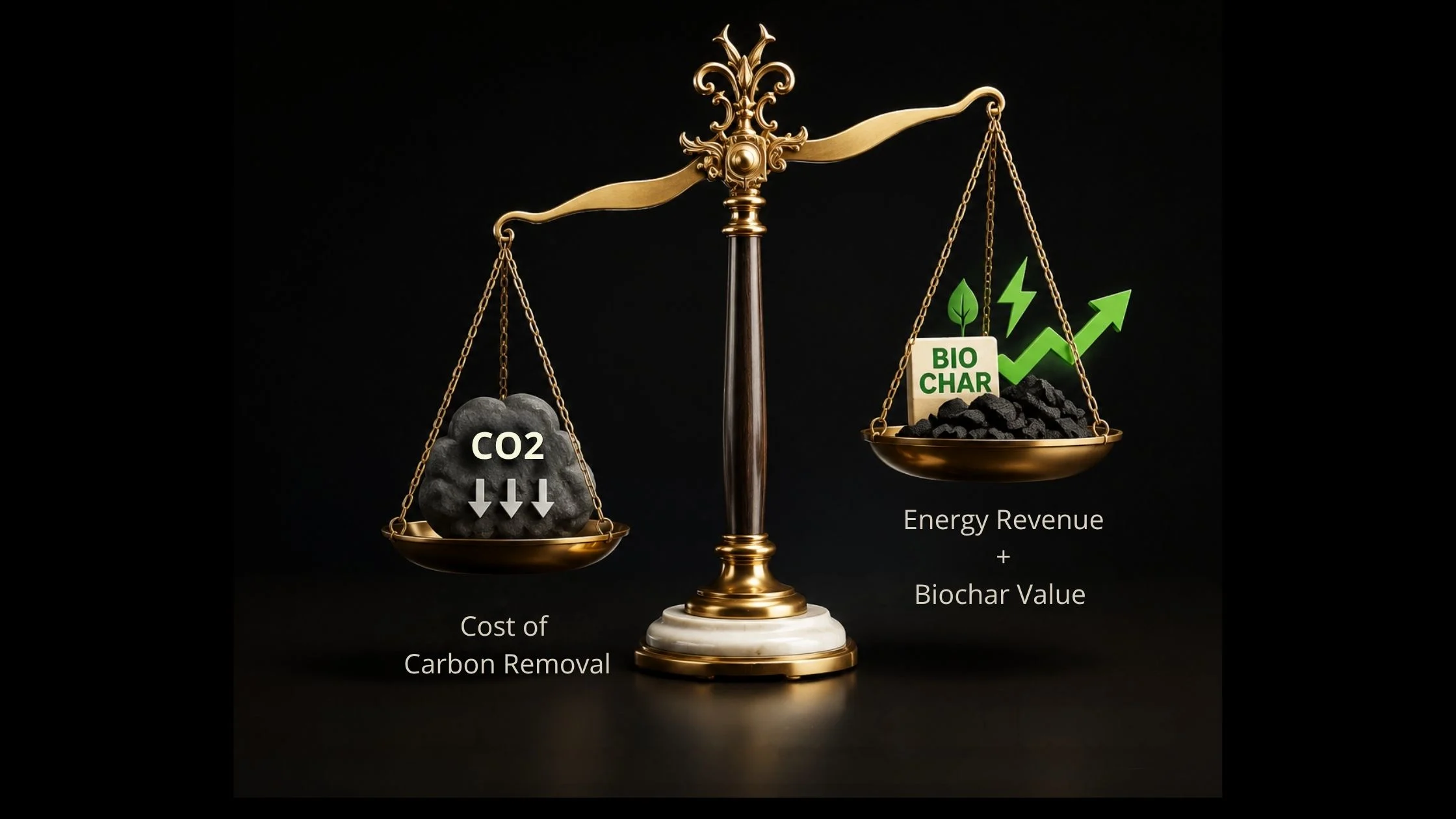
If the value of physical biochar does not increase, the cost of carbon removal will never fall enough to enable true gigaton-scale deployment.
This may be the single most important challenge facing the biochar industry today.
🪙 The Industry Has Focused Primarily on Carbon
Most biochar projects today are built around one core value proposition: carbon removal. The business model often looks like this:
Some projects generate additional revenue through biochar sales, but in many cases the biochar itself remains a relatively low-value by-product. As a result, project economics remain heavily dependent on carbon markets.
This creates a structural limitation. Carbon markets can accelerate adoption, but they cannot be expected to carry the entire financial burden of scaling biochar globally.
The world does not need thousands of tonnes of carbon removal. It needs billions. That level of deployment requires an entirely different economic model.
⚖️ The Hidden Equation Behind Carbon Removal
Every biochar project has a cost associated with removing and storing carbon. Traditionally, this cost is offset through:
- Carbon credits
- Waste management fees
- Energy sales
But there is another lever that receives far less attention: the market value of the biochar itself.
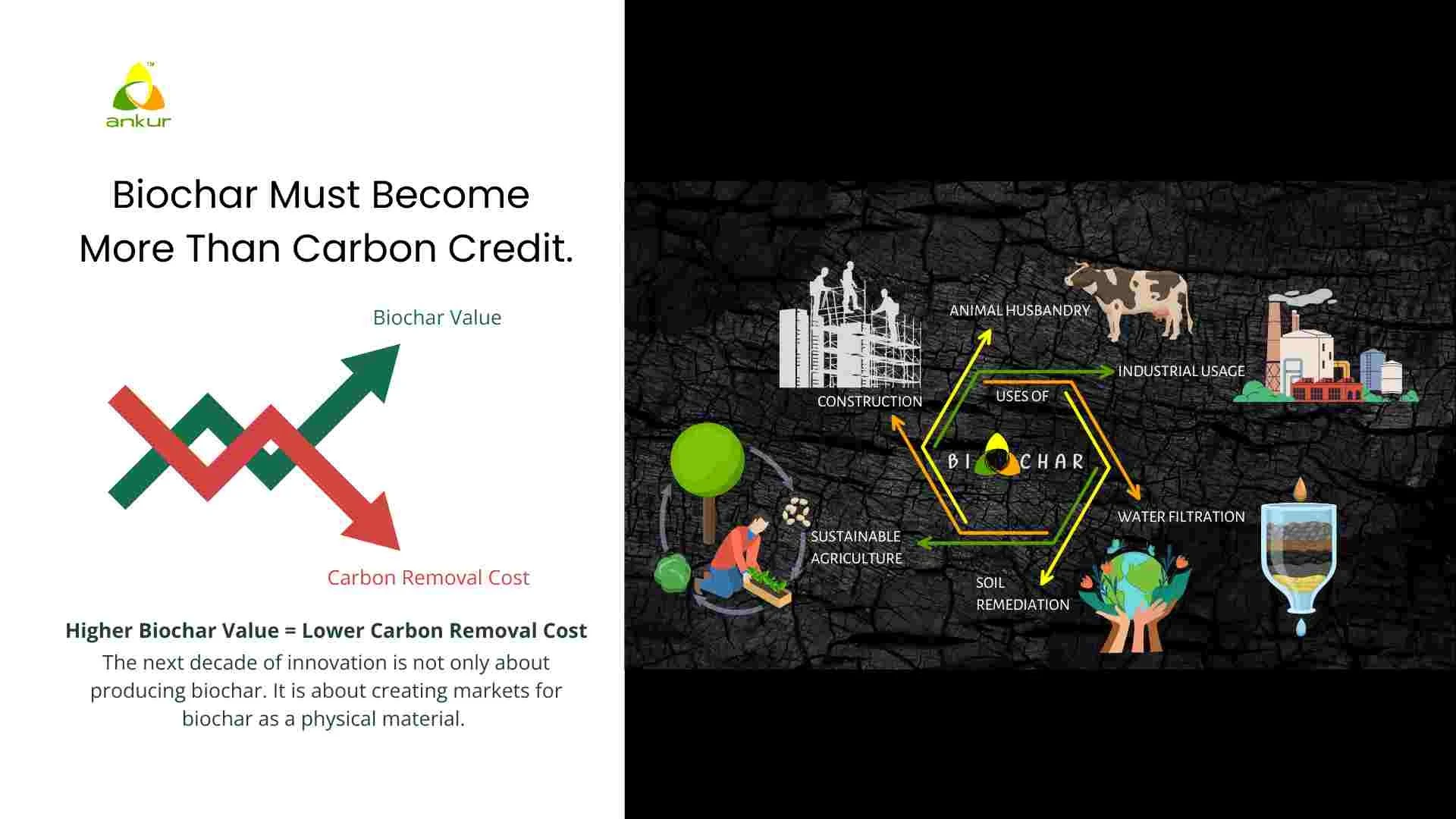
The relationship is straightforward. When biochar is treated as a low-value by-product, carbon removal remains expensive. When biochar becomes a valuable industrial material, carbon removal becomes significantly more affordable.
The industry often discusses the price of carbon. Perhaps we should spend more time discussing the price of biochar.
🔬 Biochar Is Not a Carbon Credit
One of the greatest misconceptions about biochar is that its primary purpose is carbon sequestration. Carbon sequestration is merely the beginning.
Biochar is a unique material possessing properties that are valuable across multiple industries:
These characteristics create opportunities far beyond carbon markets. The future of biochar may ultimately depend less on its carbon content and more on its material science potential.
🚀 The Next Decade Must Focus on Biochar Applications
The first decade of the biochar industry was largely about proving permanence. The next decade must focus on proving value.
The question is no longer:
"Can biochar remove carbon?"
The question is:
"What is the highest-value use for biochar?"
The answer may differ across industries and geographies.
🌍 Where the Highest-Value Markets May Emerge
🌱Agriculture: The Foundation, But Not the Destination
Agriculture remains the most mature biochar market. Applications include:
- Soil carbon enhancement
- Water retention improvement
- Nutrient efficiency
- Reduced fertilizer requirements
- Improved microbial activity
These benefits are well documented and will continue to drive adoption. However, agriculture alone is unlikely to absorb the volumes of biochar required for gigaton-scale carbon removal. The industry must look beyond soils.
🏗️Construction: Potentially One of the Largest Markets
The construction industry consumes billions of tonnes of materials annually. Researchers and innovators are exploring biochar incorporation into:
- Concrete
- Cementitious products
- Asphalt
- Bricks
- Insulation materials
- Composite building products
The implications are profound. Imagine a future where buildings become long-term carbon storage assets — each square meter of infrastructure simultaneously serving as a carbon sink. Given the scale of global construction activity, even modest biochar inclusion rates could create enormous demand.
💧Water Treatment & Environmental Remediation
Biochar's porous structure makes it an effective adsorbent. Applications under development include:
- Water filtration
- Industrial wastewater treatment
- PFAS remediation
- Heavy metal removal
- Stormwater management
As water scarcity and contamination become global concerns, biochar could become a critical environmental material rather than simply an agricultural amendment.
🐄Animal Husbandry & Livestock Systems
Emerging applications include:
- Feed additives
- Odor reduction
- Manure management
- Nutrient retention systems
These markets are still developing but could significantly increase biochar demand while improving agricultural sustainability.
⚙️Industrial Applications
Perhaps the most exciting opportunities lie in industrial applications. Researchers are exploring biochar for:
- Activated carbon replacement
- Carbon-based composites
- Polymer additives
- Battery materials
- Energy storage systems
- Process filtration media
Historically, many carbon-based industrial products have been produced using fossil carbon. Biochar offers the possibility of replacing some of these materials with renewable carbon. If successful, this would fundamentally change the economics of carbon removal.
Early-stage research area🔥 Why Energy Recovery Matters Too
While increasing biochar value is essential, it is only one side of the equation. The other side is maximizing energy recovery from biomass.
Every tonne of biomass contains years of captured solar energy. Recovering that energy through efficient gasification and pyrolysis systems creates additional revenue streams:
- Process heat
- Electricity
- Syngas
- Green fuels
- Industrial energy
When energy revenue increases and biochar value increases simultaneously, carbon removal costs can decline dramatically. This is the economic model capable of supporting large-scale deployment.
🏛️ Building Markets, Not Just Production Capacity
Today, much of the industry's focus is on producing more biochar. That is necessary — but not sufficient. The larger challenge is market creation. We need:
- New industrial standards
- Product certifications
- Application research
- Commercial demonstrations
- Supply chain partnerships
- Material performance data
The future leaders of the biochar industry may not be those who produce the most biochar. They may be those who create the largest and highest-value markets for it.
🌐 The Path to Affordable Carbon Removal
The climate challenge demands solutions measured in gigatons. Biochar has the potential to become one of those solutions because it uniquely combines:
- Carbon removal
- Renewable energy generation
- Waste management
- Material creation
But achieving scale will require a shift in thinking. The conversation must evolve from:
"How much carbon can biochar store?" → "How much value can biochar create?"
Because ultimately, the economics are simple. If biochar remains a low-value by-product, carbon removal will remain expensive. If biochar becomes a sought-after industrial material, carbon removal becomes dramatically more affordable. And when carbon removal becomes affordable, gigaton-scale deployment becomes possible.
🏭 The Ankur Scientific Perspective
At Ankur Scientific, we believe the future of biochar lies in unlocking both sides of the equation: maximizing energy recovery from biomass while expanding high-value applications for biochar.
The next chapter of the industry will not be written by carbon credits alone. It will be written by innovation, markets, and the creation of real value from renewable carbon. This aligns closely with our broader philosophy of transforming waste into energy and permanent carbon solutions through integrated engineering systems.
The future of carbon removal may depend less on the price of carbon — and far more on the price of biochar.
📩 Let's Start the Conversation
If you're exploring biochar production, new applications, or integrated waste-to-energy-to-carbon solutions — we'd be glad to discuss what's possible.
Connect with Ankur Scientific.png)